
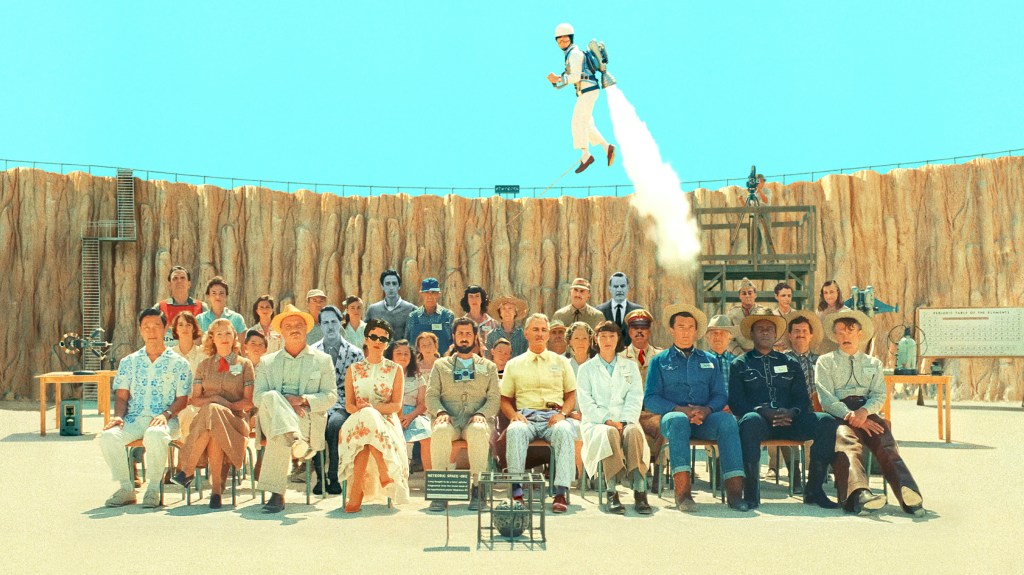
When it comes to dynamic filmmakers, there are few like Wes Anderson. For years Anderson has made some of the most creative films to hit the big screen, like Moonrise Kingdom and Fantastic Mr.Fox, and they are some of my favorite movies to see. It has only been a few years since an Wes Anderson film strolled into theaters, with the last one being 2021’s The French Dispatch, but in the midst of the summer season the zany filmmaker has brought another vibrant project to the silver screen in the form of Asteroid City.
The movie tells the story of Augie Steenbeck (Jason Schwartzman) and his family, along with an array of strangers, who wind up in the town of Asteroid City for a science event. However, after an alien shows up, the entire town is quarantined which leads to a great deal of hijinks and self-discovery. Anderson began developing Asteroid City in 2020 and intended it to be a romance film. Along with this idea was a concept inspired by Covid-19 pandemic, though Anderson stated that this direction was not intentional. This movie also sees several of Anderson’s alumni returning, such as composer Alexander Desplat, with the most notable return being distribution company Focus Features who have not worked with Anderson since Moonrise Kingdom. Being a fan of Anderson’s work, Asteroid City was an anticipated film for me; and between its creative look and massive cast it was difficult not to be enticed by the movie. So, after seeing Anderson’s latest film I can say that Asteroid City is a dynamic experience from the acclaimed filmmaker-which is saying something.
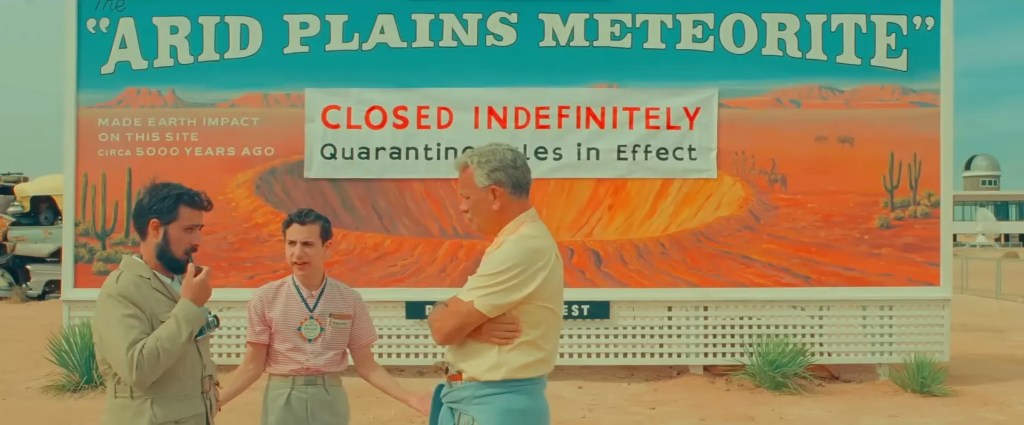
Going into this movie, I expected Asteroid City to feature an outlandish story with creative execution; and the film did not disappoint. The main story was simplistic in its narrative, but its execution made all the difference as it made this estranged tale an engaging experience. Perhaps the most intriguing aspect to this plot was the fact that it was a play within play as the movie tells the story of author Conrad Earp (Edward Norton) develops the play called “Asteroid City”. This idea was a compelling element for the story as, while it could be off-putting in places, it gave the overall film a thematic sense of storytelling that left me pandering the tale in a good way. Yet this direction could be considered a conundrum as its dueling nature made it difficult to comprehend the plot’s main message. However, I still commend this story for trying something unique and I firmly believe, through multiple viewings, this strange plot will show its true merits.

Much like the story, the cast of Asteroid City was equally an extravagant element for this movie. The ensemble features an array of actors who are no stranger to Anderson films such as Jason Schwartzman and Tilda Swinton. Schwartzman stood out in his portrayal as Augie Steenbeck as he brought his usual sense of wit to the photographer. Also, a part of the cast was none other than Scarlett Johansson as the actress Midge Campbell. Johansson was solid as ever playing the troubled actress and had several good scenes with Schwartzman’s Augie. Along with these two were several memorable characters from Augie’s son Woodrow (Jake Ryan), military general Grif Gibson (Jeffery Wright) and Augie’s father-in-law Stanley (Tom Hanks); and this is just naming a few standouts in this massive cast. The movie also featured appearances from the likes of Adrian Brody, Bryan Cranston and Margot Robbie; and their contribution to this film certainly left an impression. With the movie featuring dueling stories the cast also had played multiple roles with the most notable being Schwartzman and Johansson. This direction allowed the cast to show off their versatility, and it showed a sense of ingenuity only seen in a Wes Anderson film.

Yet if there was one area Asteroid City strived in, it was its presentation. Wes Anderson’s films are known for their creative looks and his latest endeavor was no different. In the case of this film, aspects like the cinematography were extravagant to say the least. The filmmakers aimed for the sets to feel like a diorama and the film was able to capture this concept thanks to its sense of color, and this direction was also beneficial in capturing the film’s 1950 setting. Along with the color scheme was the camerawork which gave the movie a style that was like Anderson’s animated films. As for the music, Alexander Desplat provided a fair score that added an creative flair to the movie and its thematic nature helped capture the right tone for this enigmatic feature.
Asteroid City is another bizarre classic from Wes Anderson. While some its direction could be off-putting, the movie was still enticing thanks to its thematic storytelling and stellar cast. If that was not enough then the film’s presentation was definitely up to task as it captured the film’s setting and themes in a way that was both inventive and stylish. When comparing to the rest of Anderson’s films, it is hard to say just where Asteroid City stands; but for now I can say that this strange dramedy is a eccentric cinematic experience worthy of Wes Anderson as well as the year itself.




 The Cinematic Log
Leave a comment